The golden age of "Globalization
1.0" led by the WTO has ended, and the world has entered a new stage of
"mosaic-style globalization," pieced together by 27+ regional trade
agreements such as RCEP and USMCA.
In his sharing at the closed-door meeting
of the "Hangzhou Cross-Border E-commerce 100 Forum" held on April 18,
Tiger Cao pointed out that the "extremely low price" model, which
relies solely on supply chain efficiency, has reached a dead end—"In the
race to be the cheapest, there will always be someone cheaper." The real
way out lies in building a triple value of function, emotion, and society
through four pillars: product premiumization, multi-dimensional channels, brand
narrative, and hybrid organization. This elevates the brand from a "sales
tool" to a "companion in life, a vehicle for self-expression, and a
healer of emotions."
This article summarizes the main points based on the speech transcript and is shared with you.
—Kotler Growth Lab

Part 01. A Century of Change and Non-uniform History: We Are at a "Lenin Moment"
History and life do not progress at a
constant pace; decades of calm can be followed by dramatic upheavals in just a
few months. Key turning points in society and life often condense into a few
extremely short time windows. Technology, social structures, media ecosystems,
and consumer behavior are being accelerated dramatically: the leading advantage
of AI big data models has a "shelf life" of only three weeks, and the
effective period of some traditional business models has shrunk from five years
to one year.
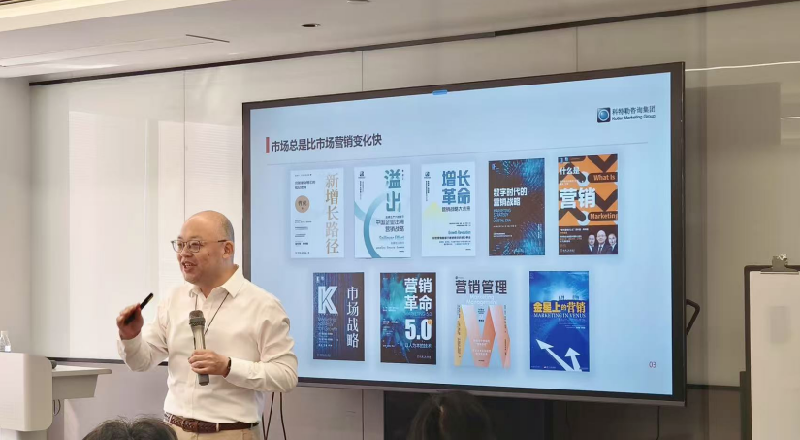
Past effective paths are quickly becoming ineffective, forcing organizations to awaken from the mindset of "practicing with a spear in the age of machine guns." "The market always changes faster than marketing." Only by understanding the non-linear nature of history can we seize the crucial moments that determine our fate amidst dramatic changes.

Part 02. The End of Globalization 1.0, the Rise of 2.0: New Rules of "Mosaic-Style Globalization"
Structural Shift in the Globalization
Paradigm:
Globalization 1.0 (WTO Era): Characterized
by low tariffs and low non-tariff barriers, global division of labor highly
dependent on efficiency, with China, as the "world's factory,"
benefiting from a unified market.
Globalization 2.0 (Today's Reality): A
fragmented system comprised of 27+ regional trade agreements—free flow within
zones, but high barriers between them (e.g., carbon border taxes, ESG
compliance, halal certification, local supply chain requirements).
The new globalization is
"mosaic-like"—globalization itself is not reversible, but it is
pieced together from trade blocks of different colors and shapes. For example,
the past model of "producing in China and selling to the US" is becoming
increasingly difficult because the US is beginning to demand diversified
production locations, "de-Sinicization."
Part 03. Exporting vs. Going Global: Two
Dramatically Different Corporate Strategies
Export Profit Formula: Overseas Price − (Domestic Cost × Exchange Rate) − Tariffs
→ Value-added is completed domestically,
benefiting from RMB depreciation.
Going Global Profit Formula: Overseas Price − (Overseas Cost ÷ Exchange Rate)
→ Value-added is completed overseas,
benefiting from RMB appreciation.
Exporting relies on domestic efficiency
benefits but faces increasingly stringent compliance thresholds; going global
requires companies to establish a complete supply chain of R&D, production,
marketing, and service locally, truly integrating into the local ecosystem.
"Whether your value-added process is completed domestically or overseas
determines whether you incur tariffs and regulatory compliance costs."
Part 04. Tripartite Drivers and Hybrid
Strategies: Domestic Demand, Exports, and Overseas Expansion Must Be
Coordinated
"Focusing solely on exports in the
short term carries significant long-term risks." The pure export model is
systematically compressed—mainstream channels (such as large chain
supermarkets) have already set localization barriers, and Trump's tariffs are
just the prelude; in the future, non-tariff barriers (carbon tax, ESG, clean
certification) will become the main entry obstacles.
Therefore, enterprises must adopt a comprehensive "tripartite" strategy:
- Strengthen the foundation with domestic demand;
- Maintain cash flow through exports;
- Lay out a global footprint for the future.
Cross-border e-commerce DTC is essentially
still a "new type of export," and needs to upgrade to "brand
globalization." Enterprises should dynamically allocate the export and
overseas expansion ratio based on product complexity and target market
maturity.
Part 05. Industrial Upgrading and Leapfrogging: Seizing the Key Window for "Leapfrogging"

Every effective adoption of a breakthrough technology is not a minor opportunity, but a crucial window to reshape the industry landscape and make a decisive impact. Historical examples include:
- Japan surpassed RCA when transistor TVs replaced vacuum tubes
- Samsung bet on LCD to disrupt CRT;
- Toyota entered the high-fuel-consumption US market with low fuel consumption, and now Chinese new energy vehicle companies like BYD are replicating this disruptive logic in the new energy vehicle sector.
Currently, China's supply chain is no
longer just about low-cost, cheap manufacturing; it has evolved to possess five
new capabilities:

Part 06. Industry Clock Model: Seven
Steps to Evolution from Extremely Low Prices to High-End Differentiation
For companies trapped in the "$0.01 phone holder on a certain social e-commerce platform" trap, Cao Hu introduced the "Industry Clock" model, using the rise of Japanese cars in the US as a blueprint:
- Extremely Low Price: Corolla sold to college students, carving out a niche with "painless cheapness";
- Relatively Low Price: Improved quality, slightly lower price (Camry);
- Cost-Effectiveness: Superior quality to competitors, price on par (Avalon stage);
- Differentiation: "I no longer compete on price; I compete on being different";
- Concentrated Differentiation: Focusing on the high-end segment, establishing a dedicated brand (Lexus);
- Increased Price, Standardized Value: Brand momentum supports premium pricing;
- Price War: Without initiating a second growth curve, ultimately trapped in homogeneous competition.
He warned, "Companies need to find a second growth point before they even begin steps seven and eight... otherwise you'll be downgraded." He emphasized, "TCL's Wang Cheng once said: 'Remember, you can't be high-end for the sake of being high-end. True high-end is about creating exceptional value, not about selling at a high price.'"
Part 07. Branding is not advertising,
but strategy: Building a Triple Value Asset
"A brand is never created through advertising." What truly drives brand building is the continuous answering of three fundamental questions:
- Who are your most important customers? (Focus like a laser)
- What are their lifestyles and usage scenarios?
- How can the product help them "become themselves better"? (Not necessarily "become a better version of themselves")
Premiumization is not about piling on specifications, but about building a triple value:
- Functional value (basic threshold);
- Emotional value (being understood, healing, peace of mind);
- Social value (identity expression, social currency, class belonging).
Part 08. The Emotional Value Revolution: A Necessity for the 21st Century
In an era of material abundance, "emotion is not just an added bonus, it's a necessity."
Cao Hu proposed "Five Major Emotional Value Structures":
- Sense of Meaning: Connecting to a larger picture (e.g., buying a Dyson for a child);
- Sense of Identity: "Judging a person by their bag"—Pop Mart's "Ita Bag" = kindness and joy;
- Sense of Healing: Jellycat dolls, aromatherapy, because smell is the earliest developing sense in an embryo;
- Sense of Surprise: "The first cup of milk tea in autumn," blind boxes of doll clothes;
- Sense of Nostalgia: Selective memory beautifies the past.
Part 09. Delving into Subcultures, Niche
Interests, and Humanistic Contexts: Breaking Through Information Cocoons
If you don't delve into real communities
like Reddit, Discord, and Xiaohongshu, and only focus on A4 (transaction)
instead of A2 (interest) and A3 (product seeding), your marketing strategy will
degenerate into a "dry transaction process."
Examples of Subcultural Goldmines:
- OC (Original Character): 120 million participants in China, 7 billion views;
- The Pain Culture of Anime/Manga: "Pain" signifies extreme passion, leading to the creation of Hong Kong-listed companies;
- Otome Games: Women fall in love with "paper dolls" due to their loyalty, thoughtfulness, and low risk.
These phenomena illustrate that society has
a large number of "unidentified information cocoons." Breaking them
can open "huge windows." Mediocre products (such as lamps and
toothpaste) can "bring a new story to their mediocre products" by
collaborating with OCs/IPs.
Part 10. The Global Operating System:
From Amazon Super-Sellers to the New Generation of Global Brands
The deciding factor is no longer a single
blockbuster product, but the ability to build a complete "global operating
system." Taking P&G's capability map as an example, its biggest node
is brand building, which is closely coupled with consumer insights, market
entry capabilities, economies of scale, and innovation.
Tiger Cao proposed the "4R+1P Structured Operation Key Points Diagram," pointing out that independent websites, content e-commerce, social e-commerce, offline key accounts, and online communities have formed a three-dimensional omnichannel network. Among these, the DTC ecosystem is particularly crucial—through independent websites and Discord private domains. Brands can directly obtain feedback, promote co-creation, increase repeat purchases, and break through the "data black box" of platform e-commerce.
Part 11. DAG-Driven Growth: The
Mathematical Framework for Deciphering the Attribution Mystery
Addressing the "ROAS dependency," Cao Hu introduces the DAG (Directed Acyclic Graph) from graph theory as the underlying logic of growth models. He points out that the famous "Amazon flywheel," seemingly a cycle, is actually an "acyclic causal chain" unfolding on a timeline. Businesses need to clarify:
- Points (marketing actions and investments) and Edges (causal and dependency relationships)
- Primary Cause (thick edge, high conversion rate)
- Secondary Cause (thin edge, low conversion rate)
The solution is to use T+N attribution
analysis: Off-site marketing strategies and investments (such as KOLs, PR)
should be observed for 30/60/90 days to assess Brand Search Volume (BSV),
organic traffic, and long-term ROI, avoiding the "time illusion."
The Marketing Health Index (MHI), as a more strategically valuable measurement tool, integrates four key factors:
- Efficiency: MER vs. Break-even;
- Expanding Reach: Number of New Customers (NTB);
- Momentum: Total Online Search Volume and Organic Traffic;
- Private Domain Activation: Repeat Purchases from Existing Customers and Cross-Category Purchases.
Part 12. Probabilistic Thinking and the
1% Rule of Action: The Underlying Weapons in the AI Era
Tiger Cao proposed two fundamental thinking tools:
- Probabilistic Thinking: "We only live once, so we mistakenly believe it to be inevitable; if we lived ten thousand times, we would know it's all probability."
- Graph Theory (Topological Geometry): Focuses on the structure of "points" (actions) and "edges" (relationships), rather than absolute positions.
In the AI era, the
human responsibility is to identify DAGs and set priorities, while AI is
responsible for execution. Without a DAG framework, large-scale model-driven
marketing planning and execution will fall into the trap of synthetic data
"self-fitting" and illusions.
【Key Action Points】
1. Immediately draw your business DAG diagram.
Because "without a DAG, AI will only amplify your chaos." Work backward from core transactions to identify primary and secondary driving factors and conversion rate weights.
2. Launch a "small-scale overseas pilot program."
Because "going global is not an either/or choice, but a hybrid strategy." Choose high-potential markets in the US, Southeast Asia, or the Middle East, establish a minimum viable local team, and test localized operations.
3. Reconstruct product value, shifting from parameters to tasks and experiences.
Because "consumers buy experiences, not parameters." Don't say "1.2-inch CMOS sensor," but say "excellent night photography, capturing my vibrant energy, like I've taken electronic donkey-hide gelatin."
4. Shift over 20% of your marketing budget to A2/A3 (interest/product seeding).
Because "companies that only invest in
A4 will suffer greatly in three years." Track long-term asset metrics such
as brand search volume and social media sentiment.

5. Audit the feasibility of brand
values.
Because "consumers look at what you do, not what you say." Check if product formulas, packaging, and supply chains are consistent with claims.
6. Hold a "Window to Industry Upgrading" seminar.
Because "every breakthrough technology adoption is a game-changer." Compile a list of key technologies that could disrupt existing products in the next three years (we've already seen high-speed motors, gallium nitride, aerogels, etc., reshape existing products).
7. Ask the team tomorrow—what is the relationship between our product and users' lives?
"Is it a tool? A companion? Or
self-expression?" This is the starting point for all brand upgrades.