Foreword
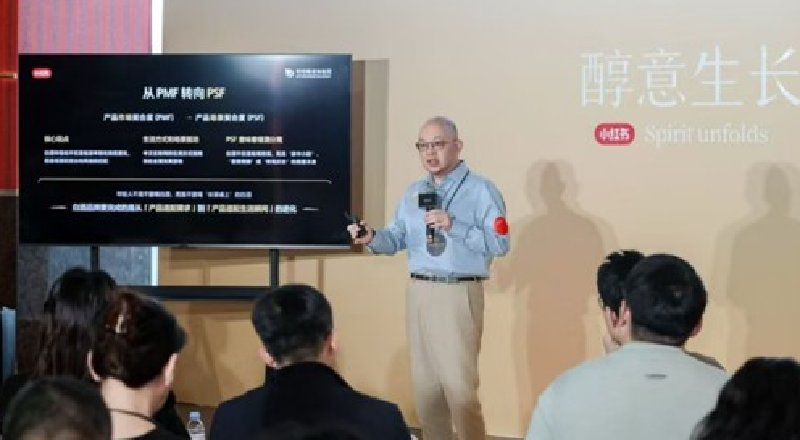
Recently, Dr. Tiger Cao, Global Partner of Kotler Marketing Group (KMG), delivered a speech at the RedNote (Xiaohongshu) Beverage Industry VIP Event in Chengdu, sharing five new growth strategies for the baijiu industry. Currently, the baijiu industry has entered a period of shrinking market volume, with increasingly fierce market competition. Specialized scenarios and product categories have become key to breaking through these challenges. Combining KMG’s practical observations and industry case studies, Dr. Tiger Cao focused on the growth paths for baijiu brands in a shrinking market, providing a systematic overview and offering practical operational references and growth inspiration for attendees in the beverage industry, helping brands overcome growth bottlenecks. The following content is from his presentation.
—Kotler Growth Lab
Currently, the baijiu industry as a whole has entered a phase of reduced sales volume, but strong growth momentum still exists in specific scenarios and product categories. Today, I will focus on the baijiu sector, drawing on KMG’s practical observations and industry case studies to share five new mindsets for brands to regain growth in a shrinking market, hoping to provide you with practical references and inspiration.
First, we must clarify a key context: China has entered an affluent market, with most industries experiencing overcapacity and consumers having an extremely wide range of choices.
Baijiu is not a basic physical need, but it is a necessity for emotions, social interactions, and everyday life—it carries people's emotional expression and social connections, and is an indispensable part of a complete life. Against this backdrop, building broad consensus becomes increasingly difficult, while the countless specific groups, scenarios, and emotions represent precisely the growth opportunities we can operate on. This is the core reason why we are shifting from an "era of massive demand" to an "era of scenario-based demand operation."
Next, I will share my insights from five aspects.

The first principle is scenario-first.
We all live in specific scenarios, formed by the intersection of time and space: Generation Z focuses on "living in the moment," while our generation leans towards "future-oriented"; spatially, people's moods and needs differ significantly in different scenarios such as home, outdoors, and camping. When the intersection of time and space is combined with human factors, an operable "operational unit" is formed.
In the past, liquor marketing often adopted a "broad-and-broad" approach, achieving growth through creating widespread consensus, massive advertising campaigns, and establishing extensive distribution channels. However, the marginal returns of this model are continuously diminishing, leading to involution.
Today, we need to shift towards refined operations, focusing on countless small scenarios and specific needs. Here, a key concept needs to be mentioned: PSF, or Product Scenario Fit. In the past, we emphasized PMF, the fit between product and market; today, the liquor industry needs to focus more on PSF, ensuring products fit specific life scenarios.

In the past, the mainstream drinking scenario for baijiu was "drinking with food," with the level of the meal often determined by the grade of baijiu. However, the drinking scenarios for baijiu are now becoming more diversified and multifaceted. Suggestions for enjoying baijiu alone, casual gatherings on mountaintops, and enjoying a light buzz while camping are becoming increasingly common; baijiu is no longer limited to pairing with grand meals.
Currently, all baijiu companies are talking about "rejuvenation," but many have fallen into a misconception—believing that rejuvenation simply means making packaging youthful and the product less alcoholic. This is merely a basic step. True rejuvenation is "youthfulness at its core." The brand's product design, drinking methods, and atmosphere creation must align with the core lifestyle and highly expressive scenarios of young people; the brand's language and personality must resonate with the aesthetics and universal values of today's mainstream young demographic. Superficial efforts are like "an ancient deity (older than Lao Deng) trying to appear youthful"—it's unlikely to truly resonate with young people.
The development of baijiu products should go beyond simple functional needs and achieve full value creation—encompassing three levels: function, emotion, and social, in line with the aesthetics, lifestyles, social needs, and sense of sophistication of contemporary young people.

For baijiu to regain its premium image, the key lies in becoming a "mental productivity force," aligning with the values of young Chinese people—this is the core competitiveness of a brand. We need to shift from "products catering to broad needs" to "products catering to the specific moments in the lives of core groups." The White Claw case is very inspiring. It didn't simply emphasize product taste, but instead built an outdoor healthy social scene that fostered self-discipline and self-expression, creating more opportunities for young people to express themselves.

The second line of thinking is narrative upgrade.
We propose launching a "New Youth, New Culture Movement" for the baijiu industry. The current narrative of the baijiu industry is too outdated, much like an intangible cultural heritage craft—advanced in technique, yet gradually marginalized due to its detachment from contemporary discourse. In the past, the narrative of baijiu was a "power narrative," but today we must shift to a "life narrative," returning to the present, returning to reality, focusing on the tangible beauty of life, and conveying the idea that "life is not far away, it's right here."

The core driving force behind the creation of any brand is "social imitation"—people emulate the lifestyles of those they admire. However, the objects of social imitation have now changed: in the past, people imitated leaders and successful individuals, believing their lives were worth pursuing; but today, these "high-risk, high-pressure" success stories are no longer envied. Young people are more interested in a "quietly sweet" lifestyle—a life of freedom and happiness without drawing attention.
Under this shift, baijiu needs to return the narrative power to consumers' "emotional sovereignty." The trend of "drinking wild baijiu" on RedNote (a Chinese social media platform) doesn't mean young people don't drink baijiu, but rather that they reject empty pronouncements about vintages and official ranks, seeking freedom of emotional expression and hoping baijiu can truly integrate into their lives. Behind this lies the fact that young people are participating in shaping a new culture for baijiu.

The "old culture" of traditional baijiu and the "new culture" of contemporary baijiu differ fundamentally: the underlying logic of the old culture is a hierarchical narrative, primarily serving decision-makers, elders, and leaders; its social attribute is the social obligation of "having to drink," and its product value focuses on "face-saving attributes" such as scarcity and vintage. The underlying logic of the new culture, on the other hand, is a lifestyle aesthetic narrative, primarily serving those who appreciate themselves, explorers, like-minded individuals, and family; its social attribute is effective social interaction "connected through baijiu," and its product value focuses on scene suitability, flavor, and emotional value. This transformation requires baijiu companies to restructure across all levels, including brand building, content marketing, product design, and channel operations.
The Macallan case is worth learning from. Its "The Macallan House" in Hong Kong and Singapore no longer simply emphasizes vintage and region—these have become the brand's foundation—but instead focuses on "what vintage and region can bring to consumers," defining the sense of sophistication aspired to in contemporary society, constructing a completely new brand culture, and making drinking Macallan a symbol of high-end, fashionable living.

The third mindset is strategic seeding.
Many companies currently view seeding as a tactical task for a specific department, which is a mistake—seeding must be a strategic move for the brand. Currently, e-commerce accounts for less than 20% of the GMV of liquor retail (data source: 2025 China Liquor E-commerce Industry Report). If the current growth rate continues, we predict that this proportion will exceed 30% in the next 5 years, with the specific growth rate depending on the efforts of each platform.
E-commerce easily falls into a "measurable trap"—over-focusing on A4 metrics, i.e., direct transaction data. Many companies' channel indicator systems are sales-oriented because transaction data is measurable and easy to track, but what is measurable is not necessarily the most important. A4 is the result; the true brand moat is built upon A2 (initial interest) and A3 (deep seeding).

Our analysis of dozens of scenarios revealed that focusing solely on the A4 metric might lead to a competitive edge in the first three years, but from the fifth year onwards, a significant lag will occur, and this gap will continue to widen. This is because the lack of front-end brand awareness, scenario-based education, and deep user relationships will cause the A4 conversion rate to decline continuously, while customer acquisition costs will rise steadily—currently, the growth rate of customer acquisition costs across various industries far exceeds the rate of inflation.
Therefore, we must cultivate A2 and A3 metrics deeply and strategically nurture our brand. Only by building a deep connection with consumers through high-quality content, lifestyle demonstrations, and emotional storytelling can we truly fortify our brand's competitive advantage.

The "Summer Special" campaign launched by Luzhou Laojiao on RedNote is a good example. Instead of directly guiding purchases, it sparked user interest and achieved deep product seeding through topics such as "baijiu with ice" and "Chinese-style cocktails," allowing users to first form the awareness that "baijiu can be drunk this way," thus laying the foundation for subsequent conversions.

The fourth mindset is 3K Collaboration.
3K refers to KOC (Key Opinion Consumer), KOL (Key Opinion Leader), and KOS (Key Opinion Seller). Only through collaboration among these three can an effective "human rights network" be built. The highest level of marketing is a "people's war"—involving all brand stakeholders, supporters, and fans, rather than the brand fighting alone.

The core of 3K Collaboration is to transform the traditional advertising and promotion model into a granular, precise content-driven approach: KOLs (Key Opinion Leaders) are responsible for brand positioning and producing professionally generated content (PGC); KOCs (Key Opinion Consumers) are responsible for word-of-mouth marketing in everyday scenarios and producing user-generated content (UGC); and KOSs (Key Opinion Leaders) are responsible for terminal conversion, bridging the last mile. Simultaneously, the channels and terminals of the liquor industry—including tobacco and liquor stores and e-commerce flagship stores—need to transform from simple sales points into fan operation bases and sources of liquor culture and lifestyle.
Store owners and top sales performers at the terminal level need to form a "dual-brand" linkage with the brand, achieving integrated online and offline operations that "cover a 3-kilometer radius offline and a county-level area online." Only through 3K Collaboration can the precision and granularity required for specific operational needs be achieved—past marketing models had too broad a scope to capture niche needs; while 3K Collaboration enables distributors, manufacturers, and terminals to form a tiered operational system, precisely reaching the target audience.

The "Osmanthus Fenjiu DIY Challenge" by Shanxi Fenjiu is a typical example. Through official initiation, KOL setting the tone, KOC follow-up, and KOS undertaking, a complete marketing loop has been formed.

The fifth mindset: Small-Demand Operations.
The emergence of AI and data platforms has brought about the biggest revolution in marketing—we can finally accurately identify "users," not just "customers," and clearly understand their consumption journey, behavioral habits, and needs and preferences, enabling one-to-one operations.
Baijiu companies need to build a "people-scenario-to-do" small-demand model, using data clustering and filtering to find high-potential niche needs. Successful cross-industry cases are worth learning from. For example, Pelliot, through user data and demand expressions on the RedNote platform, subdivided the scenarios for windbreakers into 1440 categories, and then used MaxDiff analysis (maximum satisfaction analysis) to select core scenarios, launching differentiated product combinations and achieving high conversion rates.

The same applies to the liquor industry. We need to accurately identify the "key moments" when consumers drink, and clarify their emotions and tasks in that scenario: some people drink to relieve stress and have self-reflection after work; others drink to meet with old friends and have a soul-searching conversation. Different tasks correspond to different product needs and communication methods. Brands need to guide users from both the product and communication ends to help them establish the understanding that "the right liquor is for the right scenario."

Coca-Cola's Mini Bottle and Hennessy's Mini Liquor are both successful examples of operating on small demands: Coca-Cola's 250ml Mini Bottle addresses the small demand of "healthy sugar control and finishing it all at once"; Hennessy's Mini Liquor targets the niche scenarios of "solo drinking for stress relief" and "a base for cocktails." This proves that large demands are a gamble, while small demands offer certainty—in an abundant market, operating on small demands is the only way to achieve brand growth.
Finally, I'd like to conclude: any brand, any category, is a product of its current culture.

The Birmingham School defines culture as "the sum total of all contemporary lifestyles." As a tangible representative of Chinese culture, baijiu carries 5,000 years of cultural spirit and should reclaim its pioneering spirit to lead advanced and sophisticated lifestyles. In the AI era, baijiu's best competitive advantage lies not only in its historical depth but also in its strong connection to contemporary lifestyles and living scenarios. We hope that all baijiu colleagues can grasp these five new mindsets: scenario-based marketing, storytelling, seeding, 3K collaboration (Knowledge, Technology, and Innovation), and small-demand-driven operations, to revitalize brand growth and truly integrate baijiu into contemporary life, making it a part of people's well-being.