Foreword
In company visits, what is truly valuable is not "what you see", but rather what kind of long-term logic you are moved by.
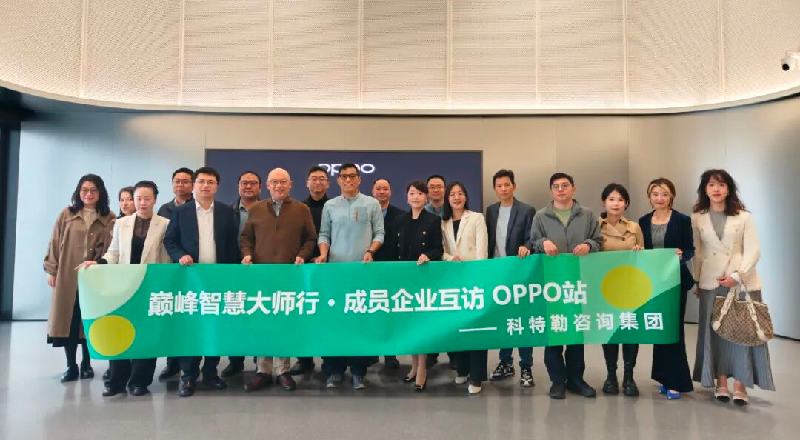
During the third session of the Kotler Summit Wisdom Master Tour, Enterprise Exchange and Kotler Going Global CEO Roundtable, Kotler led member entrepreneurs to OPPO's Marina Bay Park. From the sports and health laboratory to the corporate culture hall, they systematically experienced how a technology company can persist in doing the right thing and implement long-termism in its specific operations in a rapidly changing era.
——Kotler Growth Lab
1. From product to scenario: How can AI truly integrate into sports and health?
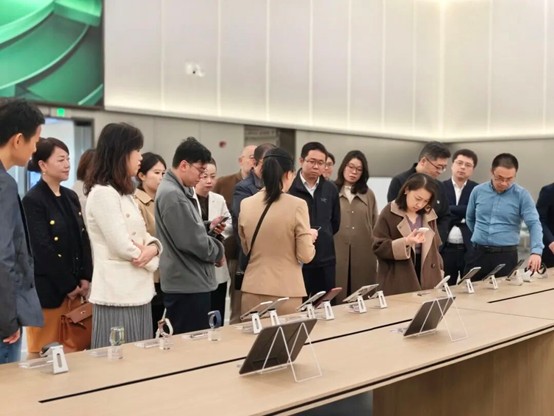
During their visit to OPPO's Sports and Health Lab, the entrepreneurs focused on learning about OPPO's latest generation of smart terminals and sports and health-related products. Rather than simply emphasizing technical specifications, OPPO prioritizes the role of AI in real-world usage scenarios. Through the synergy of algorithms and hardware, AI is applied to sports monitoring, health management, and daily use, allowing users to obtain a more accurate and personalized experience without incurring additional learning costs.
OPPO believes that good technology doesn't need to be constantly emphasized; instead, it should naturally integrate into life and truly solve problems for users. This experience-oriented technology philosophy also constitutes OPPO's consistent product direction.
2. 30-Year Evolutionary History: Technology for humanity, for good for the world

At the OPPO Corporate Culture Museum, guided by an interpreter, the entrepreneurs systematically reviewed OPPO's 30-year development history. Starting from the BBK Electronics system, accumulating manufacturing and channel capabilities with audio-visual and communication products, gradually moving towards independent brand development, and now growing into a technology company covering multiple global markets, OPPO's growth has never been achieved overnight, but rather through continuous evolution in long-term practice.
Throughout this process, OPPO has consistently revolved around a core theme: the meaning of technology should ultimately return to people and society. "Technology for people, for good to the world" is not just a slogan, but a set of underlying values that runs through product design, organizational management, partnerships, and global operations. It pursues aesthetics and experience while also emphasizing responsibility, boundaries, and the long-term health of the company.
3. In an uncertain world, persist in making the right choices in the long run

The core of the event was an in-depth presentation by Zhang Fei, CEO of OPPO India . Instead of recounting numerous success stories, he used a wealth of real-world examples to dissect OPPO's key judgments in globalization, cross-cultural management, long-term operations, and corporate governance.
A. Technology is not the goal, Long-term health is the goal
Zhang Fei repeatedly emphasized that technology itself is not the end point, but merely a tool to achieve the goal.
"Technology is always just a means; what truly matters is the kind of company you ultimately want to become. In the early stages of a business, survival is paramount, and profitability is the company's fundamental responsibility. Of course, profitability is predicated on creating value; only such a business model can be sustained in the long term."
In his view, the responsibilities of a company differ at different stages. During the survival and development stage, the most important thing is to keep things going; but as a company reaches a certain size and capability, its responsibilities naturally extend to its employees, partners, and the broader social environment. Therefore, OPPO has always focused not on how fast it can grow, but on whether the company is healthy enough and sustainable enough.
B. Globalization is not about copying. Instead, it's about re-understanding the world.
When discussing overseas markets, especially the Indian market, Zhang Fei shared numerous real and specific case studies. He pointed out that going global is not simply about transplanting China's management methods, efficiency standards, and success paths overseas unchanged.
"Many problems appear to be national or cultural issues, but in essence, they are still our own management problems."
Taking India as an example, its work habits, time management concepts, labor union system, and social structure are all significantly different from China's. The real challenge is not the efficiency differences themselves, but whether companies have the ability to understand these differences, rebuild their management methods, and redesign their communication mechanisms.
"Today it's India, tomorrow it could be Indonesia, Mexico, or Australia; the problem will definitely keep recurring."
Globalization capability is essentially a cross-cultural management and organizational adaptability.
C. Long-termism is not about being slow, but about
restraint.
During his sharing, Zhang Fei repeatedly mentioned not to be led astray by short-term temptations.
"If it's the right thing to do, there's almost no situation where it's beneficial in the short term but not in the long term; it should be beneficial in both the short and long term. Most people who say it's beneficial in the short term but not in the long term are either covering up the facts or acting out of self-interest."
When making decisions, OPPO adheres to long-term benefit as the sole criterion: it does not chase seemingly exciting but unsustainable growth, nor does it deviate from its long-term direction due to short-term opportunities. He explained this with a very relatable analogy: like exercise, it's comfortable to be lazy in the short term, but in the long run, you'll inevitably pay the price to your body.
D. Corporate culture is something that rules and regulations cannot control.
In Zhang Fei's view, corporate culture is not an abstract concept, but a key factor that actually affects efficiency and cost.
"Corporate culture is the area that company rules and regulations cannot manage."
When a company has a clear culture and aligned values, internal communication costs are significantly reduced. Often, a single glance or a quick judgment is enough for a team to reach a consensus without the need for repeated debates. Conversely, if values are not aligned, even the most comprehensive systems will amplify the costs of communication and decision-making.
E. Choose the right people first, then choose the capable ones.
During the Q&A session, when asked about how to select people with shared values, Zhang Fei provided a very direct criterion. He believes that values are not formed through assessments or training, but rather naturally emerge over time and through specific events.
"If the corporate culture doesn't fit, you don't even need to wait to see if his performance is good or bad; time and events will reveal it."
In OPPO's logic, even if people with mismatched values bring short-term benefits, losses must be cut as soon as possible because the long-term cost is higher.
4. The ultimate outcome for a company is not its size. Rather, it is a responsibility.

At the end of the event, Dr. Tiger Cao, Global Partner and CEO of Greater China and Singapore at Kotler Marketing Group, provided a clear conclusion to the entire exchange. He pointed out that as companies reach a certain stage, they are no longer just profit-making organizations, but systems encompassing a large number of employees, families, and social relationships. As companies continue to expand, what truly matters is no longer just profit itself, but whether they can continuously create a stable and valuable environment for stakeholders in the long run.
Many problems encountered by companies going global or in complex environments often stem not from external factors, but from their own internal issues: whether communication is effective, responsibilities are clearly defined, and fundamental skills are solid. Instead of simply attributing problems to the country, culture, or environment, it's better to look inward and examine whether the company has truly done what it's supposed to do.
Long-termism is not a grand slogan, but an everyday choice. It's about whether, when faced with pressure, temptation, and uncertainty, you're still willing to persist in doing the right, albeit difficult, things. Businesses cannot simply exit like capital; they must bear the consequences, correct mistakes, and move forward over time.
Tiger Cao emphasized: Throughout business history, the global economic center and the brand center have overlapped. Since China has become the global economic center, we can predict that in the next five years, hundreds of brands originating from China will become the next generation of international brands. OPPO is such a benchmark company, setting a valuable benchmark and example for the internationalization of Chinese brands.
During the exchange, Gao Chunhai, Chairman of Jiaokong Technology Co., Ltd. , Zhang Manzi , China Representative of Drucker Management Institute, Wang Wei, CEO of Langyi Technology, and Wang Xin, General Manager of Sibel Electric (Zhejiang) Co., Ltd. , all delivered excellent speeches.
Conclusion
This visit to OPPO was more than just a corporate tour; it was an in-depth practical lesson on long-termism, global operations, and corporate values. In an era where uncertainty is the norm, perhaps what's truly scarce isn't growth rate, but the ability to consistently do the right thing in complex environments. This is precisely the underlying logic behind OPPO's 30 years of continuous evolution.
"What is the right thing to do has already been written in books by sages and wise men, and we continue to learn and practice every day in order to gain the courage and perseverance to do the right thing!"
OPPO's practices and development have given every entrepreneur the courage and methods to be more determined to do the right thing.